


Diaper Free: Facts and FAQs
Going diaper free with your baby is not as hard or bizarre as you might think. In the Western world, we have been programmed to believe that babies need diapers, but in many parts of the world, going diaper free is the norm.
The belief that babies need diapers is more of a product of our Western “on the go” lifestyle and some clever diaper company marketing strategies that will have you thinking that you need to keep your kid in diapers until the age of four.
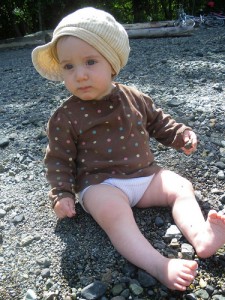 We decided (or rather, my wife decided and I followed along), to go diaper free with our daughter, Sweet Cheeks, when she was about six months old. We had been using cloth diapers with her, but we noticed that we could quite easily tell when she had to go number 2. We also noticed that she went number 2 most often when we took her diaper off. It was as if she was holding it in, waiting for the diaper to come off, because she didn’t want to be in a soiled diaper.
So, “screw that” we said, and decided to go without diapers. Sweet Cheeks is 10 and a half months old now, and we can proudly say that we haven’t used a single diaper since those fateful days four months ago. We sold all our cloth diapers too – so rather than spending money on diapers, we have made some money by selling ours!
As you can imagine, we get tonnes of questions from people who know we have a diaper free baby, and when we are in public and pull out the potty, it also raises people’s curiosity (as well as some eyebrows). So, I thought it would be best to have a Jam here to publicly answer some frequently asked questions (FAQs) about going diaper free, and also to share some facts about going diaper free that we have learned on our journey.
FAQ: Does going diaper free mean lots of messy sheets, wet clothes and a sh**load (literally) of laundry?
It can at first, but it decreases with time as you get better at it. You will have accidents, but keep in mind, even when you start potty training a toddler, you will have a few months of accidents. So, you can have the accidents when your child is a baby and deal with the wet clothes and laundry then, or you can wait until you potty train him at the age of two and deal with it then. It is almost easier to deal with it when they are babies, in my opinion, because the “amounts” are smaller. Also, I believe you can train a baby faster than a toddler, because toddlers have already gotten into the habit of not going to the toilet when they have to “eliminate,” but babies haven’t “learned” that habit yet – they are more of a blank slate in this regard – you don’t have to “unlearn” or “undo” the diaper habits with a baby who is diaper free. If that makes sense.
FAQ: If you have to do extra laundry by going diaper free, doesn’t that cancel-out the effect of not using diapers, because you are using so much water and energy to do the laundry?
No. No. No. Think about how much water, energy and chemicals go into the diaper production process. This is far greater than the amount of water and detergent you would ever use to do any extra laundry that *may be* required as a result of going diaper free. Add that to the transportation of diapers in trucks to get to your local store, and then the garbage truck that has to dump your diapers in a landfill, plus the waste that diapers leave on the earth, times the square root of 49, and the little bit of extra laundry that going diaper free might cause really pales in comparison. Also, if you use a high efficiency washing machine, your laundry will use a lot less water, soap, and energy than a conventional washing machine, so you score two extra bonus points right there.
FAQ: How the heck do you have the time to go diaper free?
Probably one of the biggest factors stopping people from going diaper free is lack of time and commitment. Like I said earlier, in our “on the go” Western lifestyle, we want a quick fix for everything. Give me a pill to stop my pain, give me a pill to ease my stress and anxiety, give me a diaper for my kid to poop in, etc. Using diapers is easier than going diaper free. There is no argument there. You still have to change the diaper, but you don’t have to be alert to your child’s need to poop or peep. You let your nose alert you to it after the fact.
Going diaper free means you need to pay attention to your child’s signals that they have to “eliminate,” and responding quickly to those signals. This grows to be a beautiful thing, where you really get in tune with your babies needs on a whole new level. Just like your baby tells you when they are hungry or they are in pain, they can and do tell you when nature is calling. And you can learn with them, and teach them, to strengthen this communication. You can instinctively know when your child has to go, and when you do, you put them on the potty and it works. It takes some work to get there, and many parents in the Western world don’t think they have the time or energy to put in the effort.
If both parents are working, you would need to have a care giver that is committed to going diaper free in the same way that you are, and that is probably difficult to find. Luckily for us, my wife stays home with our kids and has been very committed to going diaper free. It can take some motivation at first. It did for me. It is like going to the gym to exercise. At first you don’t necessarily want to make the effort, and you might question yourself and be tempted to take the easy way out and go back to using diapers. But then, once you start to see results, and you get in the routine, you get more motivated. So you stick with it. Then you get to a point where you just do it and it is business as usual. Like Johnny B. Goode playing the guitar.
FACT: The diaper industry doesn’t want you to go diaper free. Actually, they want you to use diapers as long as possible.
Well, this should go without saying. The more you use diapers, the more the diaper industry stands to profit. And the longer you use diapers, the longer the diaper companies can milk you for your cash. Pampers introduced its largest sized diaper to date in 1998 – Pampers Baby Dry Size 6. Apparently there was a sudden need for kids to wear diapers even longer than ever before. Or at least, Pampers created the need. And they had a clever advertising campaign to do so. They recruited pediatrician Dr. T. Berry Brazelton – who is a proponent of the “child-centred” approach to potty training – to do commercials for them.
In the commercial for Pampers size 6 diapers, Brazelton pleaded, “Don’t rush your toddler into toilet training or let anyone else tell you it’s time. It’s got to be his choice.” Needless to say, a pediatrician in a commercial for the largest sized Pampers to date stirred up some controversy. Another pediatrician, Dr. John Rosemond, who advocates that the potty training process is simple and straight-forward, summed up his view when he retorted that, it is a “slap to the intelligence of a human being that one would allow a baby to continue soiling and wetting himself past age 2.” I’m with the guy that wasn’t in the Pampers commercial. And, by the way, Brazelton’s research is funded by Pampers. Coincidence? I think not.
FACT: Kids are in diapers now longer than they ever have been. Ever.
Over the past few decades, the age at which toddlers stop needing diapers has been moving upward. In 1957, studies found that 92 percent of children were toilet trained by 18 months. Today, that figure has dropped to less than 25 percent, according to a large-scale Philadelphia study. A separate study performed by Kimberly-Clark, maker of Huggies, found that only 12 percent of 18 month olds are potty trained these days.
The Philadelphia study also found that only 60 percent of children today have achieved mastery of the toilet by 36 months, and 2 percent remain untrained at 4 years of age.
Think about that – 60 years ago, almost all kids were potty trained by the age of 18 months, and now, only 60 percent are potty trained by the age of 36 months. Why is this happening? I believe it is due to changes in lifestyle over the years, and those clever diaper companies that fund pediatricians.
FACT: Your baby can communicate her need to go to the potty to you.
How do you know when your baby is hungry, or tired? Babies have ways of telling you these things, and you have your parental instincts to guide you. It is the same with going to the bathroom. As hard as it may be to believe, just like your baby knows she is hungry, she knows that she has to go poo or pee. And just like she tells you that she is hungry, whether by crying, or looking at you in a certain way; she tells you that she has to go poo or pee.
The trick is to pick up on the signs, and to reinforce them. Every child communicates it in a different way – so you have to figure out how your child is telling you that he has to take a dump.
You can teach your baby sign language as well, so that eventually your baby will be able to sign to you when she has to go potty. You can do this by making a certain sign as she is going potty. Together, you will reinforce the communication and it will get easier. Sometimes, you just get the feeling that your baby has to go potty, like an instinct.
Sometimes, you get to know the timing of your baby’s potty times. For example, when waking up in the morning, after a nap, and 20 minutes after drinking. So you put your baby on the potty at these times, and it reinforces the idea of doing nature’s business on the potty.
FAQ: How do I protect my mattress, in case there are accidents in the bed?
We use a waterproof mattress pad that is really great and that I would recommend to anyone, even if you are not going diaper free. You can read about it here.
FAQ: Will I ruin a lot of clothes by going diaper free?
Not really. If you have an accident, you can rinse the clothes down before they stain. You can also find underwear for two year olds that will fit your baby when she is a bit bigger (see photo for example). Also, if you have some clothes that get stained it is not a big deal – your baby will grow out of them really fast anyways. We haven’t had a problem with this personally.
FAQ: What about when the baby is so small that it can’t support his own head? How do you sit him on the potty?
You don’t. There are different ways to hold the baby above a sink, toilet or potty before they are big enough to sit on a potty themselves or support their own head weight. Because we started going diaper free at the age of six months, we didn’t have to use these holds. If you plan on going diaper free straight from birth you will want to learn these holds. See the book I recommend below for more information.
FAQ: Would you recommend that I try to go diaper free?
Based on my experience with going diaper free, and knowing what I now know about the diaper industry, I recommend it 200%. Having said that, every family, family situation, and baby, is different. For us, it works. We can make the necessary commitments, and our daughter is a great communicator who does really well diaper-free. If you can make the commitment to do it, then I definitely recommend that you go for it. As with us, you may hit bumps along the way and want to give up, but try sticking with it, like we did, and you will have some smooth sailing down the road.
FAQ: Where can I find more information about going diaper free?
The book that we read about going diaper free, that I highly recommend is called, appropriately, Diaper Free, by Ingrid Bauer.
FAQ: Where can I find out more information about the Brazelton-Rosemond potty training debate?
There is a great New York Times article on the net about this, where I found some of the information given in this article. In the above mentioned book, Diaper Free, the author, Ingrid Bauer, also gives further insight into this debate, which is where I first learned about it.
Any other questions? Leave a comment and let me know! I hope you found this article interesting and insightful, and I wish you the best of luck!
Return to Parenting – The Dad Jam Home
Popularity: 28% [?]


Hi,
this is my first visit to Jam. I thought it was a detailed article on the topic, and I hope it encourages a few readers to look into the idea further.
We love EC and have practiced it since birth with our two boys.
I’d like to invite you to visit my site, which is about EC, and in particular in reassuring people about beginning gradually, easing into it, as going diaper free cold turkey generally freaks people out so fast they totally dismiss the idea as impossible, LOL…
Charndra
Hi Charndra, thanks for your comment, I hope this article encourages a few readers to look into the idea further too. Kudos to you for practicing EC on both your boys since birth, and on your website! Easing into it is a good idea and I would recommend that too. Hope to see you back for more future jams!
This article was incredible! Too bad I hadn’t heard of it before or I would have most definitely done it. I am just now training my three year old (yes I said three) so your statistics on when kids train while diapers are most correct.
My son ran out of diapers yesterday and I finally sat down and just talked to him and told him no more. He has to go in the potty that’s it. We don’t give children enough credit, he totally understood what I was saying and I saw it was matter of laziness to go in the diaper.
He is going to be diaper free as of today, no more saying “he’s not ready” because it’s a load (pardon the pun) of crap. Kids can do a lot if we just help them.
JP Shaw’s last blog post..the ellen show: bullying must stop now!
Thanks JP – glad you liked the article! You (and your son) can do it for sure! I think the fact that Brazelton, who is the “father” of the “child-centered approach” is funded by Pampers is all the evidence that we need to conclude that it is a load of crap. Dr. John Rosemond’s “Naked and $75″ method is much faster and more effective. The $75 is for the carpet cleaning that might be needed afterward. http://www.gastongazette.com/articles/rosemond-33894-introducing-training.html All the best!
Thanks for a great explanation of going diaper-free!
We did this with our second from birth, and although there were stressful moments, as there always are, I would do it again in a heartbeat!
One of the advantages I saw, as a Canadian mom with a year’s maternity leave ahead of me, was that I could be in charge of potty training when I was spending all this time with him. Otherwise, when you work full-time, you have to rely on a caregiver or go intensive on a weekend or (God-forbid) take a vacation to do it. And when I went back to work, I was lucky that my mother-in-law was happy to carry on with what I’d started.
We did use cloth diapers most of the time, we just didn’t put any bottoms over them. My son wore a sweatshirt, a diaper and warm socks, and still learned to crawl on our cold floors in the dead of winter. Happily. This worked for us. Then around 16 months, we got down to only a couple of accidents a day, and reliably had poop contained, so we ditched diapers and went to undies and sweatpants.
Now there are tons of potties and other products suitable for Elimination Communication out there (though you don’t necessarily need anything at all), and the international non-profit DiaperFreeBaby has support groups set up all over the world.
-Lori
Great to hear from you Lori and thanks for your comment. I am glad you liked my diaper-free explanation. Thanks for sharing your story with us too, I am sure a lot of readers will find it helpful and will find inspiration from it. When you put your mind to it, you can do anything, and it is very rewarding in the end. I would definitely do it again to if I had to do it all over again, no questions asked. Now that I have seen the results, it just makes sense. All the best.
[...] The Dad Jam had a very interesting post over the weekend about his and his wife's decision to stop diapering their daughter at the age of six months. Four months later, they haven't used a single [...]
oh. great article.
i swear disposable diapers are for the lazy parent. not that i’m trying to stir people up but they just absorb and absorb and absorb and they CANNOT be worse for the environment.
the point being if a child is not feeling the contents of the diaper, why would that be uncomfortable and why would they want to stop to use the toilet.
great post!
thanks Treemama, and I agree with you! With disposables, there is no motivation for the child (or the parent) to potty train.
I always like to read your articles – and you know that my kids are 27/15 and the potty training is almost forgotten…:-).
I am surprised to read that you can do potty training straight after the birth. You need a deep belief that it works and for me personally it would be an add. stress in the first months.
But the cloth diapers worked for both of my daughters very well and they were quite below the 18 months reaching the diaper free age.
I cannot believe that Pampers have funded the research on “child-centered approach” – that’s really bad. The need for extra large diapers brings only money for the company, soothing our conscience with the research results (and that is manipulation par excellence) and that the ads work and we follow like sheep….that’s really worrying.
Greetings from Melk
Hi Anna! Thanks for your great comment! Always nice to hear from you.
Yes, you can start potty training straight after birth and we have seen people doing it, but we started at about six month of age going diaper free. I agree, the first few months are stressful enough, trying to go diaper free during that time would add to the stress for sure.
That is good to hear that you used cloth diapers for both your daughters and that they were potty trained under the age of 18 months. That is getting rarer and rarer.
And yes, it really is shocking about Pampers funding the research of Dr. Brazleton, as it serves their purposes completely and really helps to boost their profits. I agree it is really worrying! Many greetings from Vancouver!
Great Article! My husband and I started diaperless with our baby at three weeks of age. It was absolutely amazing! The only mistake we made was stopping. We went on a trip to visit family in Ireland and were gone for 7 weeks and had her in diapers the whole time. When we returned we had to start all over again which was harder than the first time round. I think the earlier you start the better. We are back on track and enjoying again;-)
Hi Naomi, thanks for sharing your story, that is great to hear! I agree with you about stopping… I can understand that you stopped while away from home… we had a similar experience when we went to Vienna recently… we didn’t completely stop, but we used cloth diapers occasionally when we thought it would be too difficult to be diaper free. It made it harder to go back to being completely diaper free again. I think the psychology is different when you use a diaper… if you know you have that safety net, you are less likely to try to put them on the potty, even if you get the feeling that they have to go.
Good to hear that things are back on track for you. It is going well for us now too as well!
Hi,
I think I agree with you. Babies would definitely be comfortable without diapers. And it also saves you money!
Thanks.
Thanks for your comment brillkids, absolutely!
Imagine the savings of going diaper free!! We have twin baby girls and I don’t stop to add up the cost of diapers because it scares me to think about it…never mind the cost to the environment.
Absolutely Stacey, we are really happy about how much we have saved ourselves in terms of money, and the environment in terms of waste and energy. And, although the time investment is a bit greater at the beginning, in the long term there is a time savings as well (less time spent changing diapers and taking out the garbage)
This blog is noted.. I’m a dad to be.. My girlfriend is still one month pregnant.. a long way to go, i know.. but i guess im just excited.. we havent even told her mom yet who is in another country..
Greg S´s last blog ..Are you looking for a public liability insurance quote ?
Thanks Greg, time flies, so before you know it, you’ll be a dad! Enjoy the time you have now though!! I can feel your excitement!
We started doing EC with our daughter at 8 months, and our son at 4 weeks. Thanks for writing such an awesome FAQ sheet. I also wrote about EC’ing and included some pictures of the holds for kiddos on as well. Feel free to check it out: http://thepoppa.wordpress.com/diaper-fee-dad/diaperless-in-seattle/
Great Matt, that’s awesome, and thanks for your comment. Thanks for sharing the link too, those are great pics.
hi! I had visited this site several times before i gave birth last September. Since then I have learnt that while a lot of things sound good, only what works for one is what works. for example, I had not an iota of help after giving birth (unfortunately emergency c-section after 36 hours of labour). I still persevered with cloth diapers for two months after but when the diaper sprayer failed and my back couldn’t take the bending over anymore I threw the towel in and went disposable. I hate to admit this but i think being a first time mom at 42 and continued sleep deprivation to date did contribute to my lack of energy. As to potty training, I am attempting this now that he is 9 months old but I have decided not to castigate myself if it doesn’t work. I am taking four years out to just see him grow and might I add with no promises of a certain career later. At the present moment, I have a rib fracture and am still taking care of him no matter how depressed I feel. Please don’t think that I need any sympathy or pity – I just wish people would quit judging each other on how environmentally irresponsible one or the other person is and realize that just like it takes a village to bring up a child, it takes collective support from a society to enable environmental consciousness for people at all economic and social levels.
Hi Radhika, thanks for your comment, it is great that you at least tried and continue to try! I hope it works out for you, but won’t judge you if it doesn’t, I totally understand, having gone through it twice myself, and seeing a lot of other parents go through it as well. I hope that your back and ribs get better soon too!
It’s true! The diaper industry has a pretty obvious interest in keeping kids in diapers for a long as they can. I don’t think I’d be one of the ones who would try having my kids go totally diaper free, but I can see how it’s become such a ingrained part of us that most of us just sorta go along with the flow without thinking. Yeah, I see that.
Keith Wilcox´s last blog ..Road Hog! The Unwritten Rules of the Road
Thanks for your comment Keith! And going diaper free is a big commitment and not for everyone, so no worries there… but it has saved us a lot of money (and saved the environment a bit too) and has worked really well for us. It was difficult at first, but now that our daughter is two she is fully potty trained and happily tells us whenever she has to go potty, its cool!
hi,
I’m still confused.. How do you do this with a new baby? What about at night? Waking up all wet and soiled? What if they have the runs? Should I just leave them on the potty? Traveling in the car seat should I pull over on the highway and whip out the potty? I don’t get it??? My first would poop as I was nursing her, with no warning. What do you do before they start with the signs, just let them poop? How do you watch a new born 24/7 for signs or teach them signs when all they do half the day is sleep? I really don’t understand.
Hi Paigey’s Mama,
Those are many good and valid questions, and it is good to see you are curious about this.
Each parent will approach this differently. The best you can do is to read some books on this topic, and decide how far you want to go with it, and practice to see what works best for you.
Just because you go diaper free also doesn’t necessarily mean you have to go completely diaper free. You can ease into it… starting only when you are at home, for example. If you are uncomfortable doing it in the first few months, you can keep a diaper on the baby and just look for the signs, and still have the diaper as a safety net in case you miss it.
You may choose to keep a diaper on at night until you notice that your baby no longer poops at night.
We used a waterproof mattress pad, and we did have times when our baby pooped on the mattress pad. But since it was waterproof, it was no big deal. Sure, it means you have some extra laundry initially, but in the long run I feel the savings were worth it.
Do what you are most comfortable with, and don’t feel you have to rush into it. A slow approach into it is fine.
I just send my husband a link to this blog, I have a feeling he’ll get a real kick out of it (we are expecting a little one in a few weeks!)
Baby Samples´s last blog ..1 OFF Robitussin® Cough Syrup
Congratulations and thanks! Hope you enjoy it and my “Jams” will be helpful on your journey! Cheers.
heyhey
thanks for this, really interesting reading
my baby (10 months old) poops (almost always) in the middle of a meal (solids not milk). Any ideas how to use this to our advantage?
Also, I get what you do about poos, but how about wees? I have no idea when she is weeing.
Thanks a million
em
hey em, yes, you can definitely use this to your advantage… I would just put her on the potty in the middle of a solid meal and let her go on the potty. Eventually she might start doing it at the end of the meal instead… I find my daughter often poops at the end of breakfast or dinner, depending on when her last time was.
With the wees, we usually put her on the potty based on timing since her last wee or since the last time she drank something, and also depending on how much she last drank. Try to get a sense of how often she wees, and how soon after drinking she usually wees. Then just put her on the potty at these times and see if she goes.
Hope that helps!
Cheers.
Hi,
Very interesting article. Thank you for sharing. I actually found it via my pregnant sister-in-law whom posted a link to some humor on here, and I happened to look up at the hot topics and see the title for this article. Glad I followed the link. I do have some cloth diapers I have yet to use as diapers directly… but what do you do for “wipes”? You know for the sticky, sticky poo… Also, I can understand the waste and the lateness in toilet training…. as a Foster Mom I just went through my first placement and didn’t want to start toilet training until I knew the child’s life would stabilize… My husband and I got her at 13.5 months old (her 2nd foster home) and had her for 7 months. She is now with her biological parent. I really didn’t like the idea of using disposables, but in the volatile and unstable world of foster care, I am at a loss. Plus I have been working part-time.
Hi Foster Mom, thanks for your comment. I understand your not starting toilet training while the child’s life is not in a stable condition. It makes sense that the child have stability before toilet training, as any instability could upset one’s success.
For wipes, we use little baby wash cloths. We wet them with warm water, use them to wipe down, and then put them in the laundry. Sometimes you need up to three for each time you have a number two, so you need quite a few of them in total.
Hope that helps, cheers!
Wow interesting. I think in my family one of my sister stopped wearing a diaper since she 1 year old or something, all I know she was the earliest in our family, I think I stopped wearing one when 3 or something, not entirely sure on that though . Anyway take care.
Jett´s last blog ..Cool Names
[...] a long stint on the changing table with several wet wipes and fresh diaper every single time. Take it from DadJams – the solutions are simple and misconceptions easy to clear [...]
Hi there,

My baby is a month and a half old now and we decided on diaper free about two weeks ago. It’s awesome!!! she doesn’t have this much gasses as she used to, she’s a lot calmer! it’s highly recommended. And it’s not that difficult either, at least, not as I thought it might be
Larissa´s last blog ..How to Look Natural MakeUp Tips
Hi Larissa, that’s great to hear! Thanks for the comment, very encouraging for everyone out there! Cheers.
What a fabulous post! We do EC with our little girl, she is 9 months old and totally nappy free. We LOVE it and can’t understand why it’s not the norm. (ah yes those pampers rascals)
I too blog about our nappy free journey but I think you have totally managed to make it sound fairly ordinary and doable – where as I think I just make it sound totally crackers ha.
Nice one!
Sweet Lucy! Thanks so much and thanks for your comment, great to hear from another supporter! Cheers.
This piece is really helpful. I always feel confused about this issue, but now I understand.
Hi
Great blog by the way. It has lots of helpfull tips to the new father! with my kids going diaper free we do it around the house and beach. they love it! anyway keep up the great posts
Cheers
Ryan
ryan´s last blog ..Petition up date
Thank you Ryan, great comment, glad to hear it!
I don’t know if I could handle all of the extra work of laundry in the early months, since I am already tired as it is, and the house is a mess, so it’s disposable for now with my 2-month old. But one thing I know for sure is that as soon as my kid can walk, he is definitely going to be potty trained. I don’t really know if there is a good reason why a walking child can’t walk himself over to the potty (meant for his height, of course) to do his business. Is there one?
Hi Irene, thanks for your comment! I totally understand, the extra laundry is extra workload, and it is tough. I do believe a walking child is old enough to know when he/she has to go to the bathroom… some challenges are that they can’t always walk to the potty fast enough, because I think they realize it late sometimes, or, if they get too tied up with playing something, they don’t want to stop playing to take the time to walk to the potty. This can lead to accidents, but they decrease with time and if you keep an eye out for the tell-tale signs that your child has to go to the bathroom, you can catch the accidents before they happen. In any case, definitely keep up the good attitude!
Our son is 37 months old with SEVERE diarrhea issues. As a result, he is still in diapers. Only time will fix this – we are not “insulting” him nor are we and our pediatricians dupes of some sort of diaper industry conspiracy theory.
[...] reading Diaper Free: FAQs and Facts — Good answers to common EC questions and concerns, written by a dad. Elimination [...]
The chlorine in the diapers is a MAJOR reason to go diaper free. Our daughter is in and out of the doctors office.